Wednesday, June 29, 2005

Writing

I think I've mentioned on here before about how much I enjoy the first few days of working on a new book. Well, that's not always the case. Sunday I started a new one, the third book of a series in which I've also written the first two. I struggled through a couple of pages before giving up in disgust. The words weren't flowing, I didn't like what I had written, and I had a sense that it just wasn't right. The first two books in this series were written in a fairly distinctive voice that's somewhat different from my normal style, and for whatever reason, I just wasn't able to write in that voice.

Monday I had to run errands all day, so I didn't get back to the book. Tuesday I had some unexpected real-life problems to deal with, so I didn't write any then, either. So this morning I approached the computer with some trepidation. I felt like I could do it, but I wasn't sure. And there's no leeway in the schedule. This book has to be written now.

Luckily, when I began going over the two pages I wrote Sunday, I could see what was wrong with them and knew how to fix it. Once that was done I started adding new pages, and while I'm still not completely satisfied with them, I was able to have a pretty productive day. The voice of this series is back. Maybe a little hoarse and strained, but with some extra work I think it'll be okay. That's quite a weight off my mind. I've never had a case of really bad writer's block and sometimes I'm not sure such a thing really exists . . . but I worry about it anyway, in the back of my mind, in the middle of the night. What happens if the other shoe ever drops and I can't do it anymore?

It's an unsettling thing to think about.

Monday, June 27, 2005

The Omnibus of Science Fiction

A few days ago, Bill Crider posted about this anthology from 1952, especially Ray Bradbury's story "Kaleidoscope". I didn't remember the story, so today when I was at the library and happened to see the book on the shelf, I checked it out, figuring I would reread the Bradbury story. Only when I started reading it, I realized I'd never read it before. Looking at the table of contents, I don't think I ever read this book, although I read other anthologies edited by Groff Conklin. And it's quite a line-up, too, over 500 pages of stories culled from the SF pulps of the Thirties and Forties and the digests of the Fifties. So now, even though I don't really have time to do so, I have to read this book. Luckily, I can shoehorn short stories in between all the research reading I have to do.

By the way, "Kaleidoscope" is a great story. I can see why it stuck in Bill's mind.

Sunday, June 26, 2005

The Spider: Empire of Doom

Back in 1969, I picked up a couple of paperbacks in a drugstore in Stephenville, Texas, while I was on the way to Brownwood with my parents. They were wrapped together in plastic, in a "buy one, get the other free" ploy. Their titles? THE SPIDER STRIKES and THE WHEEL OF DEATH. They were reprints of the first two stories from the long-running pulp series about the crimefighter known as The Spider.

By this time I'd been reading the paperback reprints of Doc Savage and The Shadow for quite a while and was fairly familiar with pulp magazines. I hadn't heard of The Spider, but the books looked interesting and exciting, so I didn't hesitate to buy them. I read and enjoyed both of them and would have bought more books in the series, but I didn't run across them. Paperback distribution was much more haphazard in those days, when there were still hundreds of independent book distributors. It was several years later before I came across used copies of the other two Spider novels Berkley published. By that time I had learned that the first two books, the ones I'd read, were somewhat atypical of the series. They were also the only ones written by R.T.M. Scott. The others were by somebody named Grant Stockbridge. I read those two later paperbacks and was hooked on the crazily plotted, sometimes illogical, but always fast-paced and exciting adventures of The Spider. Naturally, the reprint series came to an end after four books, and I couldn't afford to buy original Spider pulps. They were already highly sought after and out of my price range.

Over the years, a few more reprints trickled out from various publishers, some of them small presses, others mass market paperbacks. I bought them all. I even came across one Spider pulp in an antique store and gladly paid the five bucks someone wanted for it. Then, a few years ago, the Spider novels began to be reprinted as handsome trade paperbacks under a variety of imprints. I've bought and read quite a few of these, and today, after many years, I finally read the fifth novel in the series, the one that was promised as a Berkley reprint but never appeared: EMPIRE OF DOOM.

Grant Stockbridge was a house name, and the author responsible for most of the Spider novels -- and the reputation the series has today -- was Norvell Page. EMPIRE OF DOOM is Page's third Spider novel. As an early effort, the plot hangs together better than some -- it was later in the series before Page's plots got really goofy. In this one, a gang calling itself the Green Hand gets hold of a terrible flesh-eating gas and threatens to turn it loose on various cities unless huge ransoms are paid. This extortion on a gigantic scale is a well-used plot -- think about Ian Fleming's James Bond novel THUNDERBALL, for instance -- but Page was one of the first to come up with it. There are a few minor twists to the plot, but mostly this novel is one nerve-wracking adventure after another as Richard Wentworth, the dashing, wealthy playboy who is really The Spider, tries to foil the schemes of the Green Hand and uncover the identity of the gang's leader. Only once that I noticed did Page lose control and throw in some developments that make no sense. That's pretty good for him.

The real appeal of the Spider series is the amount of punishment -- physical, mental, and emotional -- that Page puts Richard Wentworth through. Some pulp fans insist that Wentworth is almost as psychotic as the villains he fights. How could he not be, after all the punishment he takes? The reader is dragged along through all these ordeals, and reading a Spider novel can be exhausting, if rewarding. Many fans have advised me not to read too many of them too close together. That's good advice, I think. I love 'em, but it's better to space them out a little.

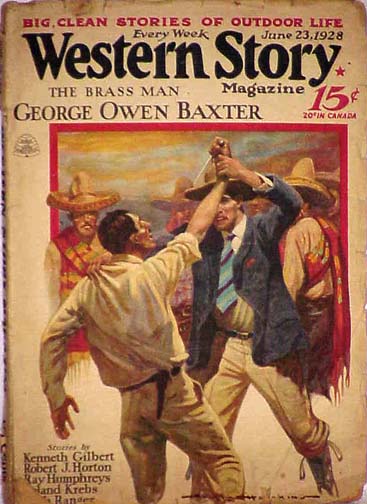
WesternPulps scan -- WESTERN STORY, June 23, 1928 Posted by Hello

Thursday, June 23, 2005

NBA Champs

Since I commented on the World Series and the Super Bowl, I suppose I ought to say something about the NBA championship. Don't expect any sort of analysis, though, because I only watched bits and pieces of some of the games, including tonight's. First of all, I'm glad the Spurs won, if only because their style of play is slightly less boring than Detroit's. Last year I rooted for Detroit to knock off the Lakers, but that was more about rooting against the Lakers (mainly Kobe Bryant -- I'm no Shaq fan, but I've got nothing against him). Overall, though, I hate the style of play in the Eastern Conference and didn't want to see Detroit win with it again. When I turned the game on tonight, it was almost down to the five-minute mark in the third quarter, and neither team had scored 50 points yet. I almost turned it off then and said neither team deserved to win. It got a little better, but not much. I became an NBA fan during the Sixties and Seventies, when the average scores were higher and the games much more entertaining. But that's sure not the trend now.

And why doesn't the NBA championship have a cool name like the World Series or the Super Bowl?

Oh, well, NFL training camps open in about a month. Something to look forward to.

Wednesday, June 22, 2005

Border Raiders

BORDER RAIDERS is the second novel in James J. Griffin's series about Texas Ranger Jim Blawcyzk, and it's even better than the first one, TROUBLE RIDES THE TEXAS PACIFIC. The previous book had some strong mystery elements, but BORDER RAIDERS is pure Western adventure, perhaps closer in tone to a war novel than anything else. The plot is simple: Blawcyzk becomes the second-in-command of a troop of some fifty Rangers sent to the Nueces Strip in South Texas to put a stop to the rustling going on there, and while they're at it, they have to track down a band of renegade Comanche warriors, too. The pace is rather leisurely at first, as Griffin does a good job of introducing the various Rangers, but once the action starts it seldom lets up, and by the end of the book the reader can't be sure which of the Rangers will make it back alive and which ones won't. This is a fine traditional Western, the sort of book that probably would have easily found a home with a major publisher in an earlier time when the market was stronger. It's available from the various on-line booksellers and from the publisher, iUniverse.

Teleport City

In recent days both Lee Goldberg and Bill Crider have linked to an article about Donald Hamilton's Matt Helm in both movies and books. Well, I had to go read that article, of course, and it's very good. But the website where it can be found is also one of the most interesting I've run across. Where else are you going to read articles about the Nick Carter, Killmaster series, the Black Samurai novels from the Seventies, and Edward S. Aaron's Sam Durrell books, also, along with Matt Helm, one of the best espionage series around? Whoever writes these reviews doesn't take them too seriously. Discussing the way authors usually describe characters in espionage thrillers, he writes, "Men with strong jawlines generally hang out with women who have proud breasts". And describing the men who run the intelligence agencies which employ the heroes: " . . . your standard issue 'old guy in charge of the most elite secret agency in the United States.' These guys are always named Hawke or Arch Angel or Mr. Falcon. I've noticed that good guys are always named after the whole bird, and evil guys are always named after parts of the bird, like Talon or Klaw or Wings Hauser."

In addition to the humor, the author also makes some pretty perceptive comments about what makes these books work or not work. The site also contains material about music and movies. I haven't poked around on those pages yet, but I'd be willing to bet that they're pretty entertaining. So check out Teleport City if you're interested in this kind of stuff. (And I think that may be a record for most number of links in a post of mine.)

Tuesday, June 21, 2005

Ace Double Covers

The image I posted of Ace Double D-18 came from an absolutely wonderful website that lists and has images of many of the Ace Doubles in all genres. If you're a paperback fan and have never been to this site, I recommend taking a look immediately -- but only if you have some time, because you'll probably be there a while!

Ace Double D-18 -- This is the book Bill mentions in his comment below, with the same cover artwork as the pulp I posted Sunday. J. Edward Leithead is one of my favorite pulp Western authors. Brad Ward is the pseudonym of Samuel Peeples, whose work I haven't read yet. Posted by Hello

Monday, June 20, 2005

Cold Service

Robert B. Parker writes 160 page paperbacks cleverly disguised as 300 page hardbacks. That explains why somebody like me, who grew up reading 160 page paperbacks, generally likes Parker's books and continues to read them.

But having said that, the most recent Spenser novel, COLD SERVICE, is a pretty rough go. To give it a "Friends"-like title, this is The One Where Hawk Gets Shot. That's not a spoiler, because it really happens before the book even starts. I don't read Parker for the plots. Out of the past dozen or so Spenser novels, I don't remember anything about the plots except for two or three of them. But it seems even thinner than usual here, the dialogue's not funny, and the posturing and the terse-but-deep philosophical conversations are getting tired. Or I'm getting tired of them. Or maybe Parker's getting tired of Spenser. I know my favorites of his novels over the past few years have been non-series books like GUNMAN'S RHAPSODY and DOUBLE PLAY. In fact, I'm looking forward to his new Western, APPALOOSA. And I'll read the next Spenser when it comes out, too. I've seen Parker go through slumps before and come out of them. But as for COLD SERVICE, I just didn't like it very much.